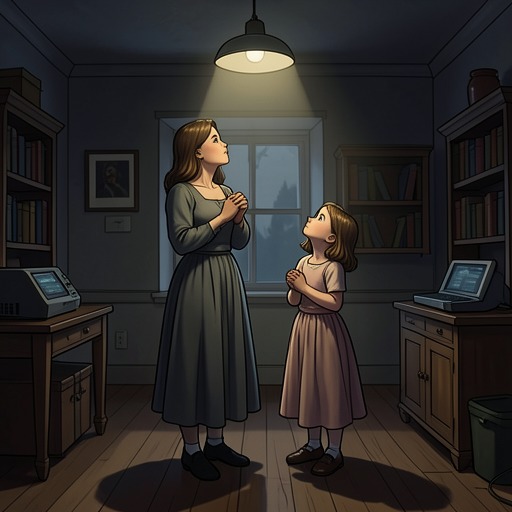
Discovering that her mother left Williamsburg because she was gay
Unorthodox: The Scandalous Rejection of My Hasidic RootsDevorah’s discovery that her mother left Williamsburg because she was gay turns a library documentary into an unexpected encounter with the family history from which she has been excluded. Seeing Rachel Levy speak briefly on screen, Devorah learns not only why her mother left but how completely that truth had escaped her; her response is a cautious act of kindness, followed by an unsettling sense of emotional distance.
Religious Doubt and the Search for Context
The discovery comes amid a widening crisis of belief. Devorah has moved from believing in God, to believing while hating Him, to wondering whether life is random. The lives of people outside the Hasidic world trouble the punitive logic she has absorbed: they appear to live without being punished for not being Hasidic. Her doubt is not simply an abstract argument about theology. It grows from comparing the rules governing her own life with the existence of people who live differently.
A documentary from the library gives that comparison a personal face. It follows gay Orthodox Jews struggling to reconcile their faith with their sexuality. Devorah watches them describe wanting to remain both Jewish and gay, and initially wonders why they would seek belonging in a religious community she sees as intolerant and oppressive. Then, as the credits roll, she recognizes her mother’s name among the contributing voices: Rachel Levy. The film has placed a hidden family connection inside a public account of identity and religious conflict.
The Revelation on Screen
Devorah rewinds the documentary. Rachel appears only briefly, stepping off a curb, but her statement is direct: “I left Williamsburg because I was gay.” In a few seconds, the film changes Devorah’s understanding of her mother’s departure. The woman she has known mainly through absence is revealed as someone who left for a reason Devorah had not imagined, in response to a conflict between sexuality and religious belonging that echoes the documentary’s larger subject.
The discovery also makes Devorah reconsider what other people may have known. She recalls that Chaya had called her mother crazy, and now wonders whether everyone understood the truth except her. Her shock is sharpened by the realization that she had never even considered this explanation. The event therefore reveals more than Rachel’s sexuality: it exposes the limits of Devorah’s knowledge of her own family and the isolation created by what has not been said to her.
A Tentative Gesture of Contact
Devorah does not feel ready to speak with her mother. Before Shavuos, however, she looks up Rachel’s address and sends a large bouquet with a special card. The gesture is deliberately modest: Devorah is not prepared for a conversation, but wants to do something kind, in part imagining what she would want a daughter to do for her. The holiday gives her a reason to reach across the distance without pretending that the distance has already disappeared.
A few days later, Rachel calls. Devorah does not answer, so her mother leaves a message thanking her for the flowers. The voice sounds to Devorah like a surprised child’s, yet carries the harder inflections of an adult who has had to become thick-skinned. Listening to the scratchy recording, Devorah marvels that this woman is her mother and that she gave birth to her, while also feeling nothing. That numbness troubles her: she wonders whether she is unable to feel connected even to someone bound to her by blood. The call establishes contact, but does not produce instant intimacy or resolve their estrangement.
Significance in the Story of Leaving
The revelation acquires further weight as Devorah confronts the future awaiting her son. She fears that when Yitzy turns three he will receive payos and begin cheder, spending his days learning Torah and entering a world of male influences from which she expects to be pushed into the background. She cannot reconcile wanting a broader life for herself with consigning him to what she sees as a narrow and limiting one. At this stage, she has neither a clear route out nor the resources to change their circumstances; her resistance remains partly secret, beneath outward observance and modest dress.
The public conversations surrounding her anonymous blog later make the practical danger of leaving with Yitzy more explicit. Readers warn that a religious community or rabbinical court may not let a mother take her child if she is no longer considered devout. Their warnings do not persuade Devorah that she must stay, but they show why independence cannot be separated from motherhood, custody, and access to education. Against that pressure, her wish to acknowledge her true self and to give her son room to read and learn becomes a concrete part of her imagined escape.
The memoir does not present Rachel’s disclosure as a simple blueprint for Devorah’s own choices. Instead, the film makes a previously unthinkable life legible: a woman can leave Williamsburg because her sexuality conflicts with the life available there. Devorah’s later reflections on freedom, and her eventual departure, give the scene a longer resonance without erasing its immediate uncertainty. The daughter reaches toward her mother with flowers, receives a voice on an answering machine, and remains unsure what she feels. The contact is small, but it brings a concealed family history into view at a moment when Devorah is beginning to imagine that her own life, too, might be otherwise.